Tuesday, January 26, 2010

Wine Entrepreneurs Conference Day 2

Sorry for the delay in posting about the second day. Despite the fact that one is away from work for two days, I’m always sad to see that the workload doesn’t take a vacation at the same time too.

The second day of the conference covered recent trends in the wine industry, and new opportunities. I’ve gathered the highlights from the second day of the conference below.

About the conference overall: as I’m stuck in one sector of the wine industry (hospitality), and have only worked in one other segment (retail), I was happy with the panels selected and the organization of the sequence of presenters (industry one day, ideas the next day). Being the first conference of its kind, however, turnout was not high, so networking was somewhat limited. You could also argue that the limited bunch made for more intimate connections, but there’s only so many times you can say “hi” to the few people there. There was a question of price too. I seemed to be one of the few paying guests there, and the price was higher than what I make in a week, and this is before travel & hotel. For that reason alone I will likely not participate next year. Which is a shame. But my company is not going to pay my way to let me network to my next job, ya know?


On to the panels:

“Wine & Social Media”
The highlight of the conference, really. Sure, I have a Facebook account. I view Twitter with a bored distaste that I used to reserve for Facebook. And that’s as far as I ever thought about social media.

This panel covered the basics of what social media is and how to use it for your company. Alyssa Rapp from Bottlenotes.com, Hardy Wallace of Murphy Goode Winery, and Stephen Gilberg from Winetwits.com were also on hand to talk about their own success using social media.

And here I thought I was on the cutting edge with my little blog.

“Franchising Opportunities in the Wine Industry”
Imagine Applebee’s but it’s a wine bar instead. That’s my interpretation of course, but it’s a brilliant concept. Wine service has a much lower labor costs than, say, a bartender (who has to be skilled and you might need to have a few on hand to match volumes). Wine is pop & pour. Add small plates that don’t require a kitchen, and you have a recipe for reasonable-margin business. The Wine Loft is a franchise of wine bars. Crazy-brilliant, right?

The founder of GiraMondo also showcased their wine game franchise ideas, that would be interesting in the right setting.

“Opportunities in Wine Tourism”
One presenter had a great business model where he imported Virginia wines to London (his homeland), but also conducted tours of the Virginia wineries aimed at British tourists. Scott Wayne has been organizing wine tourism in emerging markets like Albania, Kosovo, and Macedonia. That sounds kinda promising for all parties involved.

Keynote Speaker: Michael Evans, co-founder and CEO of Vines of Mendoza
This man taught us to use our frustrations in the wine industry to create a business opportunity. Such simple but powerful advice. I love that.

“Wine and Technology”
This was a cool panel if only because the founder of wine-searcher.com and LocalWineEvents.com were both participating. I use both of those websites nearly daily.

More recently, Eric Orange of localwineevents.com has launched WineLabelWorld.com, a community repository of wine labels. So let’s say you had a wine you liked but forgot the name. You can go to this website and describe the label (say it had a horse on it). This search engine would then pull up all the labels it had that were tagged ‘horse’ and maybe you’ll recognize the wine you had. Of course, this would be difficult to describe a German wine label, or maybe one of those pretty script labels from Burgundy… The model is built on the hopes that user will upload pics of wine labels.


“Innovation in the Wine Packaging Industry”
I think Mr. Boisset’s keynote speech on the first day got me pumped about new wine packaging, but this panel did not much follow-through. We did get to see some samples of the 750ml aluminum wine bottles. And ReCork America is collecting corks for the purpose of…making flip flops? I guess it’s better than letting cork breakdown naturally in the landfills? I think I’m missing something here…

“Angels and Venture Capital in the Wine Industry”
And here’s where I was to meet my financier to take my business plan to the next level. Except I’m missing an actual business plan. And assets. And I really don’t have positive cash flow either. As you can imagine, the venture capitalists are still very gun-shy, especially as most wine businesses don’t have assets (land & machines) that are worth much as security. The panelists here advocated building contacts who can be your angels years before you actually need them.

Brother, can you spare a dime?

Sunday, January 24, 2010

Black Ridge, Pinot Noir 2006 (Central Otago, New Zealand), $29, 13.5%

A few years back I was a Garagiste Wine junkie. It was a painful day I had to unsubscribe to their tempting emails, but I had a mortgage to pay, so no more impulse buys (damn you, internet). It was that bad.

I’ve had a 90% success rate with Garagiste’s selections, meaning I never tasted a thing they offered before I bought it, and I loved 90% of that. To me, that’s an awesome hit rate. And their draw is very affordable wines too. See why I was heading down a path to poverty?

On to the wine.

It’s actually really yummy. Burgundy it is not, but the wine is going down the path of ripe California fruit + minerality like you’d find in Burgundy + New Zealand funk I get on a lot of Central Otago wines. All three components in equal amounts. That green rot ‘funky’ has always turned me off on New Zealand Pinot Noirs, and here it’s subtle enough to add complexity. Medium intensity of classic red-fruit Pinot Noir aromas jump out at you and the sour fruit finish goes on for about 30 seconds. Really yummy. Sad I only picked up four bottles.

Saturday, January 23, 2010

1997 Chateau Carras (Cotes de Meliton), $26 (retail), 13% abv

Where??!


Do you know?


Don't scroll down yet!


I’ll give you a hint – this wine was a Bordeaux blend plus a little Limnio.


Give up?


It's from Greece.

Cotes de Meliton is on the Khalkhidhikhi peninsula in northeastern Greece. (Yea, I can’t believe you didn’t get that either.)


Yep, at CityZen last night in Washington DC, I had a 12-year-old Greek wine to go with my venison. Ok little wine. $80 was price of admission for the novelty (way overpriced list overall, but it's located in a hotel).


‘Twas an elegant, rather than brawny, Bordeaux blend. Didn't draw much out of the additional Limnio.


In other words, the wine was meh.

Building a great wine list. Part 3: Nuts & Bolts

In the first two posts I looked at the Wine Spectator awards and the choices of wine list formats. Now on to the meat of the matter.

Food
It’s obvious, but I’m going to say it: you need to populate your list with wines that go well with food. A steakhouse decked out with amazing verticals of German Rieslings, as much as I love them, doesn’t work. Nor do cult California Cabernet Sauvignons at a sushi joint. I’m the first to admit that it’s difficult to resist the urge to stock up on amazing wines, but if your kitchen is not turning out anything with an earthiness that could play well with a Vin Jaune, you should really pass.


Breadth
That said, you should also make sure there is something on your list for everyone. I’m not saying you need every wine or every region, but major styles that are in harmony with the menu should be represented (even if the sommelier doesn’t particularly like those styles, ahem, herself). It helps to ask some of your regular customers what they think is missing from the list.


Pricing
What about pricing? I’ve heard lots of formulas over the years and the most popular seems is to have the average bottle price equal the price of two entrees. Fair enough. I’d say that 60% of the list should hover around this price point based on absolutely no research except my gut instinct.


Length
Finally, how many wines does a list need? Obviously, we’ve established that the length of the list does not automatically make it a great list. How long the wine list should be is difficult to determine, but I suspect this is usually dictated by the amount of proper store space more than anything. If we assume you’ve got as much space as you want, then the list is really a function of the food and the customers.


Physical Presentation
Ok, this has been the biggest sticking point with my latest project. The wine geeks favor some sort of book, a small book, but something with pages. The non-wine geeks favor a one-single-page format. Clearly this was more of a problem of length.


Still, this subheading gives me a fabulous excuse to mention the Aureole’s eWineBooks, they claim to be the world’s first wireless wine books (good luck getting one that works). Then there’s Clo Wine Bar’s iTune-esque wine menus beamed from overhead to the table, which becomes something of a touch screen. These e-novelties allow you to find wines and drill down on more information including tasting notes, varietals, and appellations.


Both of these last two innovations are way cool but with so much information at your fingertips, I’d miss the human interaction with a sommelier. I doubt either technology is going mainstream anytime soon.


PS – we’re still undecided.


Staff
All of the above said, my favorite wine lists are always the ones where the staff can talk you through it. You can have all the most gorgeous wines in the world on your list, but if a guest asks for help deciding between a Sancerre and a New Zealand Sauvignon Blanc, and the server shrugs his shoulders, I’m sure you've just lost a wine sale when that table finally decides to just have a beer.


Conclusion
So what makes a wine list great? I think a great wine list is one that is connected to the food served at the restaurant, one that reflects what your guests are looking for, and that can be delivered by a trained staff.


So simple. Not so easy.


Pic: Rubber Slippers in Italy via flickr

Nikolaihof ‘Von Stein zu Mautern’ Riesling Smaragd 2002 (Wachau), $50, 12.5% abv

I’m a sucker for locally-driven and organic cuisine, so should you ever find yourself with a free night in Washington DC, I recommend heading over to Nora in the Dupont Circle area. Nora is America’s first Certified Organic Restaurant meaning 95% of the ingredients are organic. But don’t go thinking this is a ‘health food’ restaurant. Instead, take comfort knowing that the quart of heavy cream used in your risotto is organic heavy cream.

In addition to a lovely seasonal menu, Nora presents an interesting wine list. The list is sprinkled with top organic and biodynamic producers including Chave, Meo Camuzet, Tablas Creek, and even Nicholas Joly’s Coulee de Serrant (my favorite wine in the world, ahem, in case you’re looking for a birthday gift idea).

However, I skipped the 2004 Coulee de Serrant on the list last night (I prefer them closer to ten years old) in favor of a 1990 Nikolaihof ‘Vinothek’. The damn thing was corked and they couldn’t sell me another. (By the way, I have a theory about the high rate of corked wines from Austria in the early 90s but will save it for another post.) I ended up enjoying a 2002 Nikolaihof ‘Von Stein zu Mautern’ Riesling.


Side note, the Wachau area in Austria has its own quality designations for wines based on grape ripeness (three special levels in the Wachau). Smaragd (smah-RAHG) is the highest level of ripeness, with an alcohol level of more than 12%.

On to the wine: I love Rieslings with age on them for the petrol notes they develop. In this case, I found intense aromas of stones and minerals jumping out of the glass where I thought petrol would have developed. (These were my immediate scribbling before I found out that ‘Von Stein’ means ‘from stones’.) Otherwise, I got loads of lemon zest, ripe yellow apples and pears. The palette is well-balanced between its medium body, acid, and finish. This is a dry Riesling, though not painfully so. I find Nikolaihof wines to be less austere than other producers in Austria.


One last note, see that ‘Demeter’ logo on the back label? Nikolaihof is a biodynamic producer. Biodymanic goes a step beyond organic farming by incorporating lunar rhythms into decisions in the vineyard and winery. Seriously. More for another post…

Friday, January 22, 2010

Wine Entrepreneur Conference 2010

I’ve studied wine as an academic subject, but I’m kinda lost when it comes to understanding all the different players in the wine industry and what they’re up against. So I was naturally interested in the Wine Entrepreneur Conference 2010 held this week in Washington DC (ok, fine, and I'm a conference junkie).

The conference advertised itself as “the only professional wine conference focusing on wine entrepreneurship” and panels were arranged so that the first day covered the wine supply chain and the second day looked at trends (i.e., social networking) and opportunities (i.e., franchising, packaging). Many of the speakers were harvested from the east coast, which was refreshing to see. Here are my key takeaways from each of the panels:


“Wine Making and Winery Development”
The mid-Atlantic growers (two from Virginia and one from Maryland) all envied where Oregon’s wine industry is now. Despite this, there seems to be no momentum behind a regional growers’ association to collectively promote the wines outside their area. I got the impression that each winery is fighting its own fight for shelf space instead of joining forces to present to the quality wines of the mid-Atlantic to consumers and trade. A promotion similar to Uncork New York! does in Manhattan would go a long way to elevating the relevancy of this region to the public.

“Wine Importing and Distributing”
Oh, the damn three-tier system of booze distribution in this country is so simple on paper, but not easy in execution. The number of government agencies involved in importing a single alcohol-related product is amazing, and this is before considering the paperwork for bank financing. Mr. Earle, formerly of the Bureau of Alcohol, Tobacco, and Firearms, used his part of the panel to discuss the key factors for success for New World entrants to the USA.


“Managing Wine and Liquor Stores”
Retail has its challenges, but is not dead. Certainly cost cutting and inventory management has been important over the last year, but the key to success in any type of retail is engaging your customer, whether through free tasting at your store or keeping track of customer’s past purchases to help them find something new they might like.


Keynote Speaker: Jean-Charles Boisset, Boisset Family Estate
Mr. Boisset made a strong case for thinking creatively around wine packaging in the future. I had no idea they packaged some of their AOC Beaujolais wine in 750ml aluminum bottles. Is that even legal?


“Managing a Wine Bar/Hospitality Business”
The tighter economy has lead to creative solutions for smaller restaurants. The consultants who presented here shared that, in certain markets where is it allowed, they have collectively leveraged pricing power and purchased for several restaurants.

“Opportunities in Wine Journalism/Wine Blogging”
It’s a great time for wine freelance writing as newspapers are cutting full time staff so there’s more opportunity to contribute. It’s a terrible time for wine freelance writing as it’s ultracompetitive given so many unemployed professional writers. Mr. Meddis shared his ‘Top 10 Tips & Tricks’ for effective blogging.

I have a lot to learn.

“Wine and Charity: How to Use Wine in Charitable Ways”
Both Vintner’s Charitable Cooperative and Charity Wine have original ways of channeling our love of wine into significant cash for charity.

Day two highlights to follow...

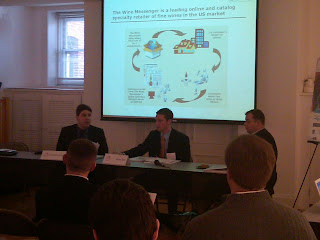
(Picture L-R: James Roth of Red, White, and Bleu, Rodolphe Boulanger of The Wine Messenger, and Laurent Guinand of GiraMondo Wine Adventures.)

Wednesday, January 20, 2010

Chateau d’Auvernier, Chasselas 2008 (Neuchâtel, Switzerland), $25, 11.5% abv

Finding unusual wines that are affordably priced on a wine list is one of life’s joys. On a recent weeknight visit to Artisanal, I tried a white wine from Switzerland made from the Chasselas grape. Made by Chateau d'Auvenier in the Neuchâtel region of Switzerland (Neuchâtel is in Western Switzerland just over the border from France's (and Switzerland's) Jura region).
Let me just stop and say that I love that they offer about 100 wines by the glass at the restaurant, both as a taste or a glass. France dominates the by-the-glass wine list followed by the United States, but Italy and Spain gets their own section too. There are also southern hemisphere wines so you can get your Australia/Chile/Argentina fix as well. There’s a bottle list beyond that including a good selection of half bottles, but with so many by-the-glass options (and I find turnover to be fast enough that I’ve not had a dead wine yet), I haven’t had a reason to commit to a full bottle.


Back to the wine. Chasselas (aka Fendant in the Valais region of Switzerland) is grown in France and Germany with some distaste, but the grape has found a home in Switzerland where it is the most planted grape variety.
This wine showed medium intensity aromas of ripe lemons, grapefruit peel, stones, and something of a Alpine mountain floral-ness. It seemed to have a little more weight in the mouth than the alcohol would suggest, and the medium amount of juicy acidity mingled with lemon and a slight amount of pine flavors. It was a little too light to be a perfect match for the Duck Bourguignon I ordered, but this was a case of matching a unique wine to the person, not the dish. I’d like to serve this as an aperitif or a picnic wine on a hot summer day.